
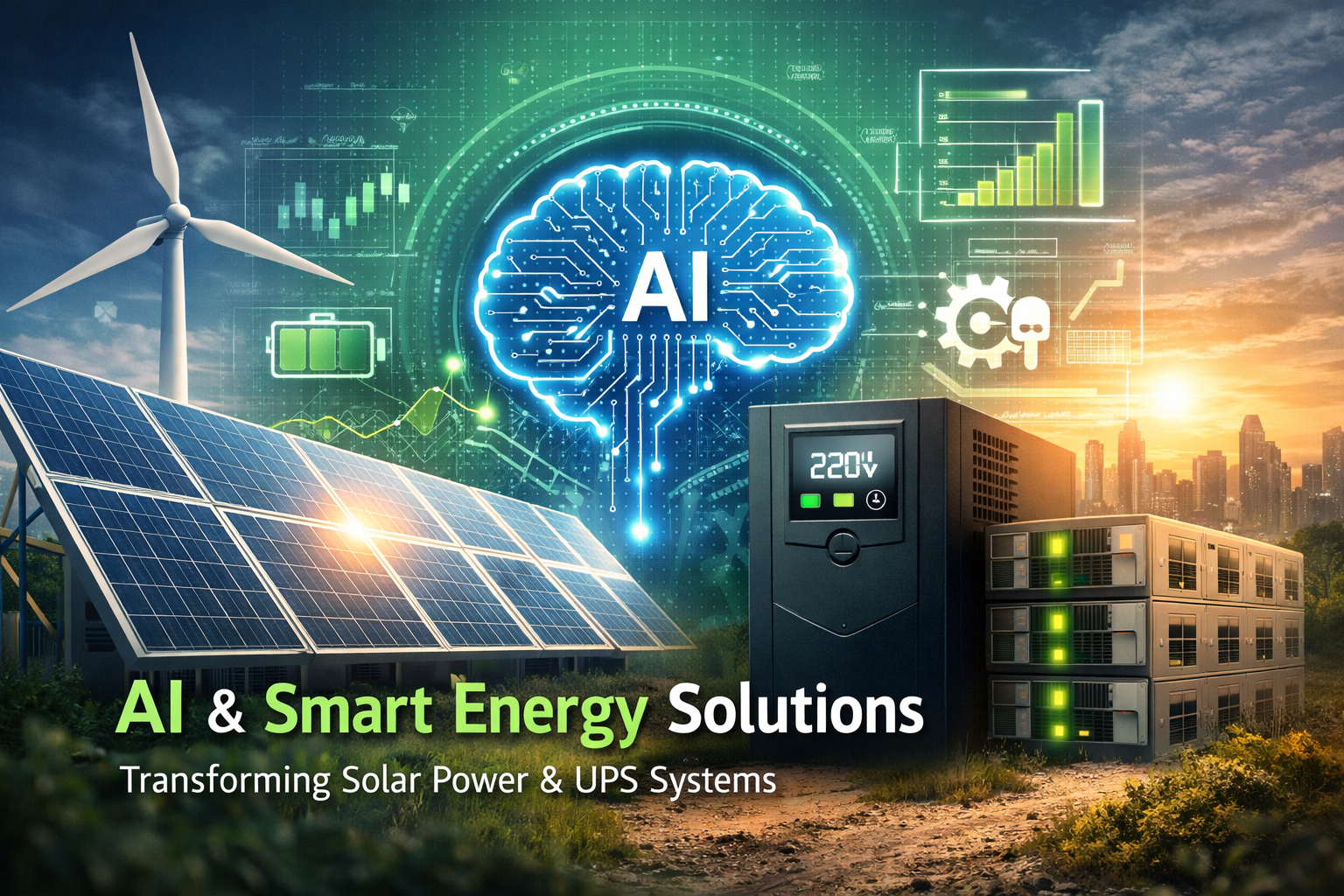
AI Energy Impact on Solar Power and UPS Systems
Artificial intelligence (AI) is reshaping how renewable energy and backup power systems operate. As the demand for clean electricity continues to rise, AI is becoming a key technology that improves efficiency, reliability, and system performance. Although solar power and UPS solutions serve different purposes, AI brings meaningful benefits to both.
1. AI Makes Solar Energy More Efficient
AI is transforming photovoltaic (PV) systems by making them smarter and more responsive. Because solar power depends on weather conditions, traditional systems often struggle to predict output accurately. However, AI can analyze real-time data and create precise forecasts, which significantly improves energy planning.
In addition, AI-powered monitoring tools help detect panel faults, shading issues, and inverter errors before they cause major losses. As a result, system owners can reduce maintenance costs and increase overall energy production.
Moreover, AI helps solar plants automatically adjust settings to match sunlight conditions. This optimization ensures stable output even when the weather changes quickly.
2. AI Improves Battery Storage and Energy Management
As solar systems increasingly use home or commercial batteries, AI becomes even more important. Because AI can predict user behavior and energy demand, it enables smart charging and discharging. Consequently, batteries last longer and store energy more effectively.
Furthermore, AI can balance power between the grid, rooftop solar, and on-site loads. Through this intelligent distribution, users experience more stable and cost-efficient energy usage.
3. AI Enhances UPS Reliability and Performance
Although UPS systems are designed for backup power, AI takes them to a new level. First, AI helps predict battery health, internal temperature, and component aging. Since early warning is crucial for sensitive equipment, AI monitoring prevents unexpected downtime.
In addition, AI can improve transfer time performance by analyzing switching behavior and optimizing internal control logic. Therefore, devices are protected more quickly during power failures.
Moreover, AI-assisted load management ensures that the UPS only powers the most important equipment when battery time is limited. This smart decision-making helps users avoid unnecessary shutdowns.
4. AI Reduces Operational Costs for Businesses
Many companies face rising energy costs and increasing power demands. Because AI can monitor usage patterns and find inefficiencies, it helps reduce energy bills. Furthermore, AI recommends the best times to charge batteries, use solar power, or switch loads.
In large facilities, AI can integrate solar systems, UPS units, and generators into one coordinated strategy. As a result, businesses gain greater stability and lower operating costs.
5. AI Supports Predictive Maintenance and Remote Monitoring
Traditional power systems rely on manual checks, which can be slow and expensive. However, AI enables predictive maintenance that identifies problems before they become serious. For example, AI can detect UPS capacitor wear, solar inverter faults, or cable temperature changes.
Because this monitoring works remotely, technicians receive alerts instantly. This reduces repair time and improves overall safety.
6. What AI Means for the Future of Solar and UPS
AI is not replacing human experts, but it is giving them better tools. As AI continues to evolve, solar systems and UPS devices will become more efficient, reliable, and user-friendly. In the future, we can expect seamless integration between solar energy, battery storage, and backup power — all controlled by AI.
🔚 Final Thoughts
AI is creating a major shift across the solar power and UPS industries. Through smarter decisions, predictive insights, and real-time optimization, AI helps users save energy, protect equipment, and achieve better performance. Because of these advantages, AI will continue to play a central role in the global transition toward cleaner and more stable power systems.
Learn more about AI in renewable energy from the International Energy Agency.http://iea.org
